How Much Does a Hotel Bathroom Vanity Cabinet Cost? Cost Drivers per Unit for Bulk Orders
There is no single price for a hotel vanity cabinet, because the unit cost is the sum of board, worktop, hardware, finish and logistics choices. This guide shows how each layer moves the budget so you can plan bulk orders with confidence.
Hotel bathroom vanity cabinet cost cannot be answered with one number, because two units that look similar in a render can differ widely once the board, worktop, hardware and finish are specified. What you can do is understand which components carry the cost, and which decisions move it up or down. This article breaks the unit price into layers so you can build a realistic budget and compare quotations fairly.
We do not quote prices here, because they depend on the project, the market and the specification. Instead, we show the structure behind the price, so that the figure you eventually receive makes sense.
Why a single price per vanity is misleading
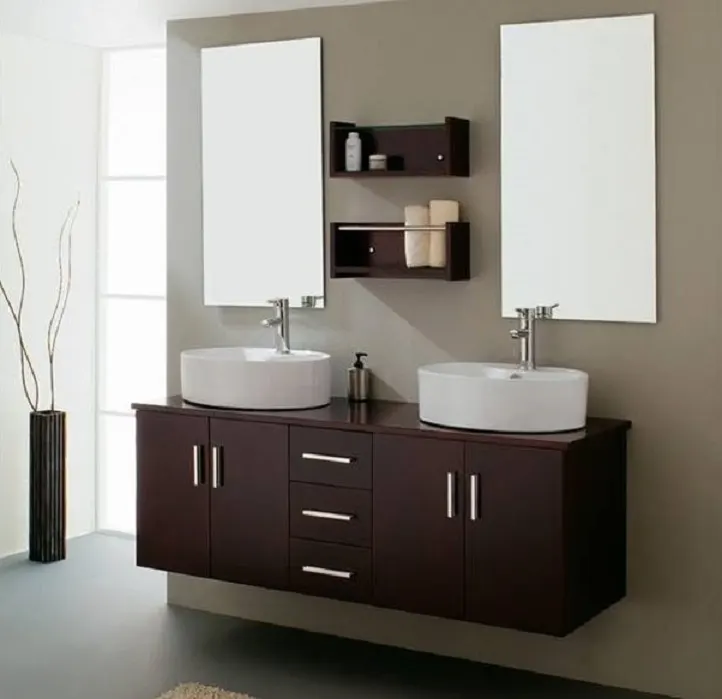
A vanity is not one product but a small assembly: a carcass, fronts, a top, a basin, hardware, sometimes a mirror or lighting, plus packing and transport. Each part has its own supplier chain and its own range of quality levels.
When a buyer asks for a vanity price per room, the answer only has meaning if the specification is defined. A quotation that says one number without listing the board type, top material and hardware brand is hard to trust and impossible to compare.
The main layers of per-unit cost
Think of the unit price as a stack. The relative weight of each layer changes by project, but these are the layers you will meet in almost every quotation:
- Carcass and front boards
- Worktop and basin
- Hardware (hinges, runners, handles, fixings)
- Finish (laminate, veneer, lacquer, stone-effect)
- Design, drawings and sampling
- Packing, shipping and installation
Layer 1: Board choice
The board forms the body of the cabinet and is the main defence against humidity. Standard MDF or particleboard is the most economical, but it is vulnerable at cut edges and near plumbing. Moisture-resistant MDF, HPL-faced boards and marine plywood cost more per square metre, and each behaves differently in a wet room.
Board thickness also matters. A 18 mm (0.7 in) carcass costs more than a 16 mm (0.63 in) one, but it holds hinges and runners better and sags less under a heavy top. Savings on board often return as repair costs, so it is worth weighing them against the expected service life.
Cost-related questions about boards
- Are only the exposed faces moisture-resistant, or the whole carcass?
- Is the back panel full thickness or thin hardboard?
- Are the cut edges sealed, and with which method?
Layer 2: Worktop and basin
In many vanity units the top is the single most expensive component. Laminate and HPL tops sit at the lower end, solid surface and engineered stone in the middle, and natural marble or granite at the upper end, particularly with thick edges, book-matched veining or complex cut-outs.
The basin type changes the price too. A drop-in or undermount ceramic basin is a separate item, while an integrated solid surface or cast stone basin combines top and basin into one more expensive piece. Remember that the cut-out work, polishing of edges and tap hole drilling are priced separately in many quotations.
Stone adds a logistics effect as well. Heavy tops need stronger packing and affect freight cost, so their true price is higher than the material alone suggests.
Layer 3: Hardware
Hardware is a small part of the unit price but a large part of the guest experience and the maintenance bill. Hinges, drawer runners and handles are used many times a day in a hotel, and the difference between basic and commercial-grade hardware shows after a few years.
- Hinges: soft-close, stainless or coated, with adjustment in three directions
- Runners: full-extension, soft-close, with a stated load rating
- Handles and pulls: material resistant to humidity and cleaning chemicals
- Fixings: wall brackets or rails rated for the weight of the top
If a quotation uses a well-known brand, ask whether an equivalent can be approved. Substitutions can reduce cost, but they should be agreed in writing against a clear specification.
Layer 4: Finish
The finish affects both appearance and cost. Melamine and laminate are the most economical and hard-wearing. Veneer gives a natural timber look but needs a protective lacquer in humid bathrooms. Multi-layer lacquer, especially in matte or deep colours, takes more production steps and is therefore more costly, and it can show marks more readily.
Special effects such as fluted fronts, stone-effect surfaces or metal inlays add machining and handling time. Choosing a finish that suits the bathroom's wet conditions is usually a better use of budget than choosing the most elaborate one.
Layer 5: Size, complexity and variants
Dimensions affect material use directly, but complexity matters more. A plain rectangular unit with two doors is much faster to build than a curved front, a corner unit or a cabinet with integrated lighting and several drawers.
In a bulk order, the number of variants is a major cost driver. Each additional model or size means more programming, more setup and more checking. If you can reduce a hotel from six vanity types to three, the saving per unit is often larger than any material downgrade, and the design keeps its character.
Layer 6: Drawings, sampling and mock-up
Design support, shop drawings and a mock-up unit are real work, even if they are spread across the order. For a large order, these costs are shared across many units and become small per piece. For a small order, they weigh more heavily on each unit.
A mock-up is worth the investment. Changes made on a sample are inexpensive, while changes after production begins can be costly and delay the opening schedule.
Layer 7: Packing, shipping and installation
For overseas projects, the delivered cost is more than the factory price. Export packing with corner protection, crates for stone tops and clear labelling by room number add cost, but they reduce damage on arrival.
The Incoterm in the quotation also changes the comparison. An EXW price excludes freight and export formalities, FOB includes loading at the port, CIF includes sea freight and insurance, and DAP covers delivery to the destination. If you are comparing two offers, make sure they are based on the same term. On-site installation, if needed, should be listed as a separate line.
How bulk quantity affects the unit price
Quantity helps in several ways: material is purchased in larger lots, machine setup is shared across more units, and packing can be optimised. However, the effect depends on how identical the units are. A hundred identical vanities are cheaper per unit than a hundred units split across many sizes and finishes.
Timing also plays a role. Raw material prices, currency movements and factory capacity at the time of ordering can all influence the quoted figure, so a quotation normally has a validity period.
A simple table for budgeting
| Cost layer | What moves it up | What keeps it controlled |
|---|---|---|
| Board | Marine plywood, HPL-faced boards, thicker panels | Moisture-resistant MDF with sealed edges |
| Worktop | Natural stone, thick edges, integrated basin | Solid surface or HPL, standard edge profile |
| Hardware | Stainless parts, high load runners, soft-close | Approved equivalents against a written spec |
| Finish | Multi-layer lacquer, fluted or inlay details | Laminate or HPL in a durable colour |
| Variants | Many sizes, left and right versions | Fewer models repeated across room types |
| Logistics | Stone tops, DAP delivery, site installation | Consolidated shipments, clear Incoterm |
How to compare two quotations
When two offers differ, the first step is to line up the layers. Check board type and thickness, top material and edge, basin supply, hardware brand and load ratings, finish system, packing method and Incoterm. Most of the price gap normally comes from one or two of these lines.
Also check what is missing. Quotations that leave out the basin cut-out, mirror, installation or crates look cheaper but lead to extra cost later.
What to send to get an accurate price
To receive a quotation that reflects your project, prepare the following:
- Room schedule with the number of each vanity type
- Bathroom elevations or drawings with dimensions
- Preferred materials and finishes, or a design brief
- Basin and tap details, and who supplies them
- Destination, preferred Incoterm and target delivery window
Next step
If you are budgeting for a new hotel or a renovation, send us your drawings or room schedule. We will review the vanity package, explain the cost drivers line by line and come back with options that fit your specification and timeline.
Sıkça Sorulan Sorular
What is the biggest cost driver in a hotel vanity cabinet?
In many projects it is the worktop, especially when natural stone or an integrated basin is specified. Board quality and finish come next. The balance depends on the design, so a line-by-line quotation is the best way to see where your own budget is going.
Does ordering more units reduce the price per vanity?
Usually yes, because setup, material purchasing and packing are shared across more units. The effect is strongest when units are identical. A large order with many sizes and finishes may save less than a smaller order with only a few repeated models.
Why do two quotations for the same vanity differ so much?
Differences usually come from board type, top material, hardware brand, finish system, packing or the Incoterm used. Missing items such as basin cut-outs or crates can also make an offer look cheaper. Compare the specification line by line before the totals.
Is the factory price the same as the delivered cost?
No. Factory price (EXW) excludes freight, insurance, import duties and installation. FOB, CIF and DAP include more of the journey. Always confirm which Incoterm applies and what the offer assumes for packing and on-site work.
How can I reduce vanity cost without lowering quality?
Reduce the number of variants across room types, choose a durable laminate or HPL finish, keep the top and edge profile simple and approve equivalent hardware against a clear specification. Keep moisture protection at edges and joints, as repairs cost more than the saving.
Every hotel project is different. Send us your drawings or room schedule for a tailored proposal on materials, lead time and shipping.